Patrick Davidson Roberts
Having continued to get older to such a degree that I’ve stopped pretending I’m not taking it personally, and having moved house in the past year, the periodical time has come for a chucking-out of trash and a debunking of several aphorisms that are taking up space in my life that I need for other things.
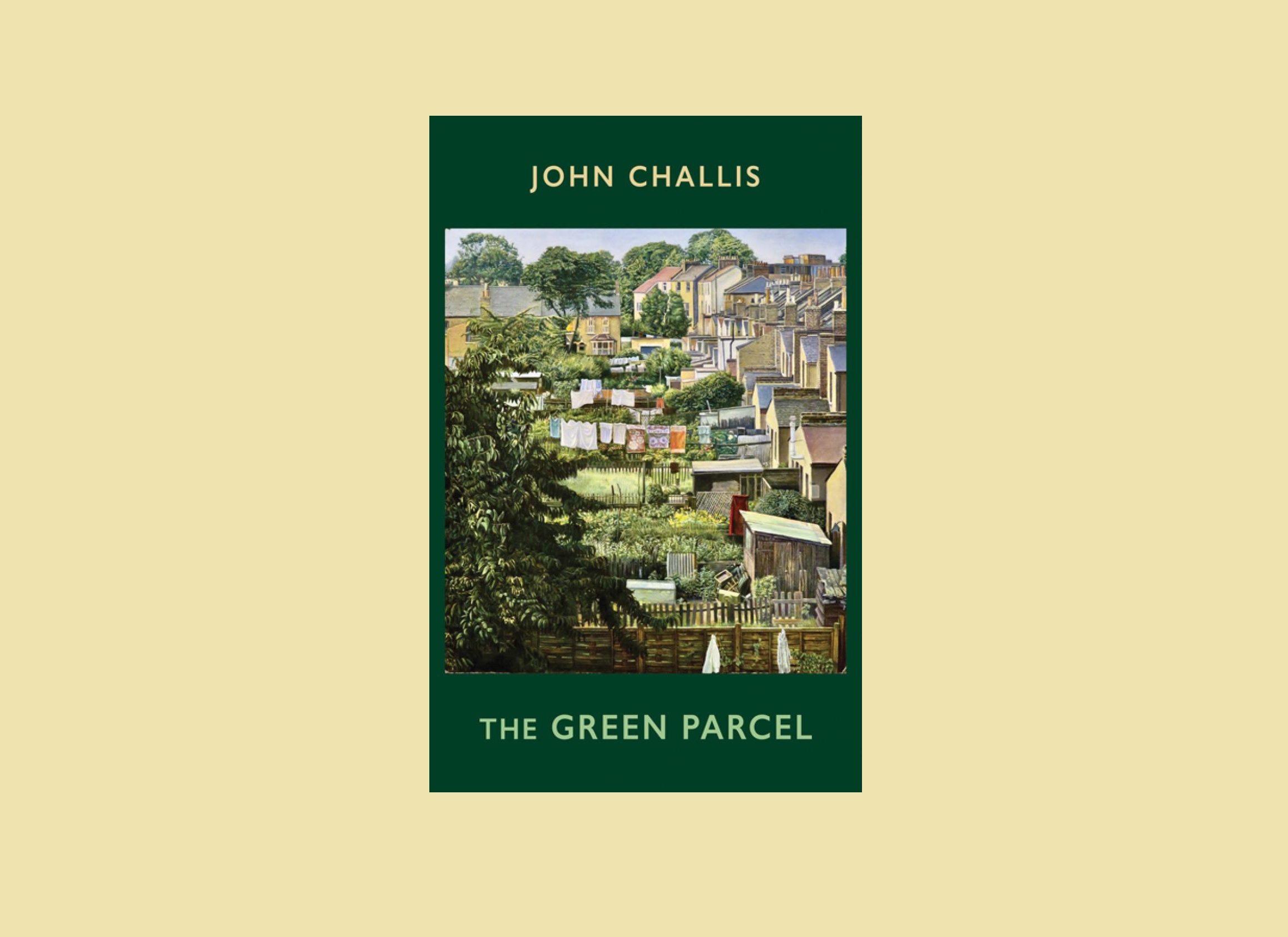
Chief among the latter is ‘Never judge a book by its cover’. Leaving aside the challenges inherent in selecting a book at all if you’re so pure of spirit that you refuse to actually look at what it is and by whom, I’ve long suspected this to be a humourless charge. I am glad to be confirmed in this by the verdant cover of John Challis’ second collection The Green Parcel (Bloodaxe, 2026), which could not more sharply contrast with the black and white photograph that fronted his debut The Resurrectionists (Bloodaxe, 2021); one of the reasons for my rejection of the above aphorism is because there is no way that this is accidental on the part of the poet or his publisher.
The only danger in my discarding is to seem to simplify the relationship between the two books to an unhelpful degree. It is nothing earth-shattering to reflect that the evocation of history, labour and a certain toughness found in the first book’s cover also spoke to the often-urban, late-night/early-morning, concrete settings of many of the poems, any more than to associate the leafy and pastoral light of the second with a more rural psychogeography in much of its poetry. Things can be both simple and helpful.
Challis belongs to a group of poets (I looked for the Greek word and there isn’t one, yet) whose debut was launched into and had to battle the pandemic, and so entered a near-immediate wraithlike state of being weirdly out of time. While I understand the frustrations of that group for their debuts (launches cancelled, few in-person readings, those half-filled rooms instead entirely empty), in Challis’ case the book is more than good enough to live on its own, and The Resurrectionists to a degree benefits from what we might term an instant afterlife. Its poems are clear in their evocations, both conjuring and conveying the lives past and gone, as well as never allowing the historical to be rendered entirely separate from the living and the current. Reading it as I did during the second or third lockdown, it peopled the streets of the silenced city around me, becoming both a book of its time and out of it.
With The Green Parcel, there is an equally impressive depicting of an extrascape, which also leans into an at times literally earthier expression. Here is articulation and exhibition of things described that manages to enter almost the mythic in world-building. Entrances entice and entrap in equal measure, as in ‘The Fields’:
Shoulders back, we enter
what we thought were passages
through the wheat and find
ourselves expelled to other fields.
Another poet might have needed an ‘instead’ after ‘ourselves’, whereas Challis declines to say whether the expulsion to other fields is or is not in fact the passage that was sought, in both senses of that word. A sense of the entrance concealed is a constant, enunciated most bluntly in ‘What we know’:
No one knows, but access to the gardens
must be through the gaps in window frames
we’re yet to find. And what we know
is never right: we do not know
if each one’s wings are patterned like a fingerprint
and if these markings are unique.
That ‘what we know is never right’ doubles down on the elusive and retreating thing sought, but with a beguiling rather than frustrated payoff.
Again and again the book goes down below the surface of the described and depicted world, and the verdant colours and twinkling pastoral of above (as in the title poem, and ‘The Fields’) turn out to have been gateways to the different colours of below:
down go our lives
to where the redirected river
cools the growing temperature,where what only echoes
echoes underground.
Here, in ‘Data Centres’, the descent is cast as the inevitable quest, and its immediate predecessor, ‘Angler’ (below in full), brilliantly sees the moment of crossing over:
He wrestles with the water
and draws to the surfacea lump of solid liquid
that comes aliveas it nears the net,
mustering in its defencethe whole pond and pulling him
as much as he is pullingwhatever’s on the line
towards the edge.
That central comma marks the flipping of the poem, turning the tables on angler and reader alike. Meanwhile, going underground –
We dig or else conduct a survey
and bit by bit we find the things
born or created. Our work is time,
time it takes to know the filmtime has laid. We hope our shovels aren’t like fires […]
We are not miners but disciples
and work to spread belief in land
not as commercial but sacred interest.
In this, ‘The best is still below’, the unearthing becomes literally that – the vitalisation and raising of the ground, both of the past and the soil, both archaeological and resurrective. The sense of the discovered is also one of recovery, as enunciated in ‘Underhouse’:
I must have been a stone once,
satisfied with stillness. I watch the dark
dilute the corridors and can holdthis pose for hours. There’s pleasure
in being anchored.
While a playful sense of the impersonated is present here, there’s also one of half-recognition of a former state or of a form being recovered. Challis’ subterra, far from hell, seems to be a place of accreditation, of value – to be there is to be instructed and entrusted, as the speaker at the end of ‘The Mausoleum’ finds, beneath the redundant structure:
Built to hold, it never held, built
to mourn, it never did. Today,
after the storm, I came and found
this poem sleeping in the crypt.
There’s a sense here of – right though below may feel – don’t get comfortable. Indeed, the subjects of ‘Minor Gods’ (surely a phonetic trick as a title) evoke:
[…] Orpheus, who by his nature
yearns to find a way back to the surface.
For another constant in The Green Parcel is one of the nearing and unseen threat, the menace just outside of comprehension, found worryingly domestic in its presence:
Oil to the hinges, how quietly
the doors of ground open when
it pours down, and who knows
what is exiting, thirsty for answers.
			(‘Rain’)
To you, we give the eggshells,
the coffee grounds and flayed leeks,

the tea bags and strawberry scalps:
enough to keep the Green Man

in leftovers for weeks,
our offering to the garden,

to fend off what would have us
if it could.
			(‘Compost Heap’)
With ‘Compost Heap’, it would be easy to locate and limit the threat entirely into that close, but Challis has already laid a quiet savagery, with more than a hint of guilt, in the flayed and scalped fruit and veg. As much as the ‘offering’ might be seen as routine, it might also be in compensation and beseeching, like Larkin’s ‘weak, propitiatory flowers’.
Without overburdening Challis’ work, Larkin comes to mind several times in the book, most clearly in the close of ‘Parties’ (‘while there’s still time’), but reinvented and repurposed in ‘Cathedral’. No simple update of ‘Church Going’, what this poem does instead is to invert incarnation, turning the gentle dependence of god on man in Larkin’s poem into something a lot earthier and clear:
From now on,
god will be the one
in need of us.Screaming
little god passed
from breastto arm, to breast,
[…]We stand above,
tall and dark
at any hour,alert as towers
at the birthplace
of our faith.
A taut and loving poem of parenthood, it nonetheless deploys a mutability of tone that means it can be read as a menace itself. Like ‘Church Going’ it shifts from the iconic to the serious, but Challis’ poem’s anthropomorphic resolution lends that seriousness a certain brawn Larkin (not that he needed to) wouldn’t find.
Parenthood was a concern for Challis in his debut, and continues here. No other poet presently writing is marrying creation with destruction this deftly – pairing life and death so carefully and, for me at least, so bravely:
I tried
to think of reading,
but all my thoughtswere fuel
to the single
thought of hercrackling
in the corner in her
wicker bassinet.
As with ‘Cathedral’, read it either way you want: the gentle sound of crackling that of a peaceful sleeping infant, or the fear of the worst occurring because of something that you have fuelled. In ‘Veil’, Challis makes the connection as lucid as possible:
A friend says:
birth’s the time
the veil thinsbetween worlds.
She comes through.
I cross overand find
that I’m blind there.
The poem goes on, like ‘Angler’, to execute a reversing of forces in water and light that flips the speaker and subject, and again it is a choice for the reader as to how that powerplay is read. In the book’s final poem, however, Challis opts to hold the two worlds presented together, just for a time, exploring both the light and the dark in the poem’s title – ‘Wreath’.
The Green Parcel does not lend itself to easy summation, and nor should it. Poetry of this consistently high quality is for the reader far more than the critic. I stand by my recommendation to judge it by its cover because its cover tells us that it is a poetry collection by John Challis, and that means we need to read it.
John Challis will be reading with Patrick Davidson Roberts at The Betsey Trotwood, London, on the evening of Wednesday 8th July. More details about this free event can be found here.