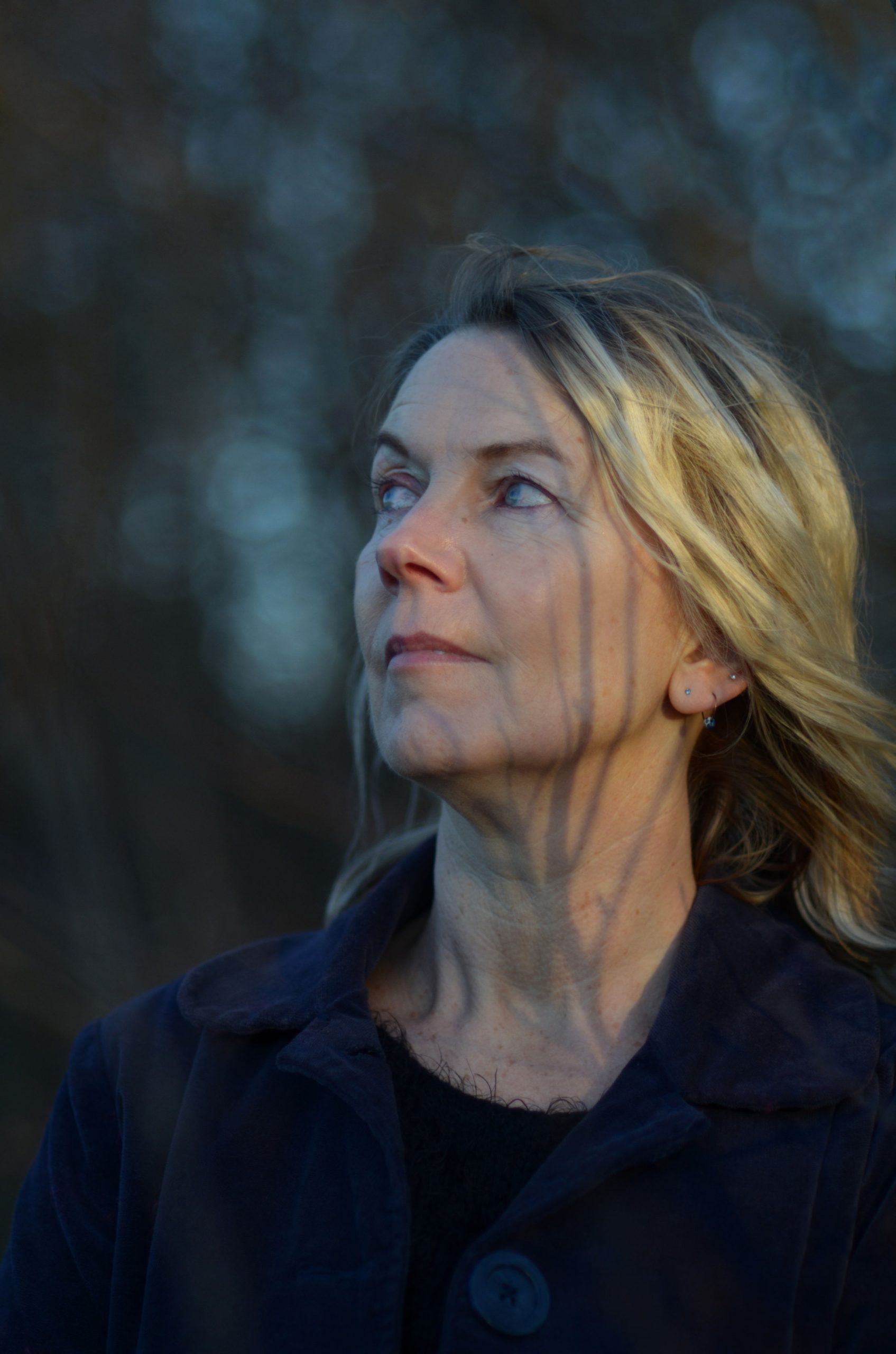
Katharine Towers is a poet and poetry editor. She has published four collections with Picador, most recently The Worrying Rose (June 2026). Her previous collections are Oak (2021), a Poetry Book of the Month in the Guardian, The Remedies (2016), which was shortlisted for the T. S. Eliot Prize, and The Floating Man (2010), which won the Seamus Heaney Centre Prize. In 2023 The Maker’s Press published let him bring a shrubbe, a pamphlet about the life and work of the English composer Gerald Finzi. HappenStance Press published The Violin Forest in 2019.
Below, Katharine speaks to Suzannah V. Evans, whose new pamphlet, How Running Is, was recently published by Guillemot Press.
Suzannah: I would like to start by asking you a very broad question about poetry and what it is, for you, and whether your feeling about poetry – what it is and what it’s for – has changed over the course of your writing. Emily Dickinson famously wrote that ‘If I feel physically as if the top of my head were taken off, I know that is poetry’, while for Wordsworth poetry ‘takes its origin from emotion recollected in tranquillity’; for Audre Lorde, poetry is ‘the skeleton architecture of our lives’. How might you put words to your own sense of poetry?
Katharine: First of all, I want to thank you for these tremendous questions, which I so enjoyed pondering . . . What is poetry and what is it for? I don’t think I really know. But if I hang up that question like a little seed crystal, a few thoughts do begin to appear. As it happens, I chose an Emily Dickinson quote for the homepage of my website: ‘If I read a book and it makes my whole body so cold no fire can warm me, I know that is poetry.’ I chose it because I love its uncompromising absoluteness. Dickinson says in a single sentence what I feel: poetry must be all, and if it’s not it’s nothing.
I think of a poem as being like a bird’s egg, an object like no other. There is nothing we can ask it or ask of it – all we can do is hold it very carefully in our hand and not mind if we don’t understand. I’m also of the view that poems are there (mainly) to be beautiful and true. No doubt this is very old-fashioned. If a poem speaks truly but isn’t beautiful, I sadly feel it is a half-made thing. If a poem speaks beautifully but isn’t true, I find it rather flimsy and hollow.
I expect all this sounds terribly fanciful and highfalutin. If I had any such thoughts when sitting down to write I would certainly tear up my notebooks and throw away my pen. Perhaps what I mean is that language at its most charged and precise and urgent can’t help giving us something we didn’t have before. That something doesn’t have to be insight or meaning or understanding. I would describe it as being to do with necessity – the sense that an idea or a thought or a feeling has been put into particular words and will now always exist (best) in those words. Here is something new, written because it had to be.
I don’t know whether this is what I’ve always felt. Probably I used to write poems out of curiosity – I would sit down to find out what it was about a tree or a hailstorm or a piece of music that had caught my attention. Why would this thing not leave me in peace? I still like to start a poem with that sense of unknowing (indeed I think it’s essential), but I’m not as bothered as I used to be about getting to the bottom of things. The writing of the poem – the looking and listening and thinking and putting into words – is more than enough. Poems don’t have to get us from A to B. Perhaps this is a way of saying that I have come to think that poems are first and foremost about language. In a mysterious way, language generally knows what it’s doing and perhaps we do our best work when we put ourselves into its hands.
Suzannah: The Worrying Rose is a book of singing – and perhaps this relates to that first question about what poetry is or might be. Notes, melodies, and fragments of song resonate throughout the poems – most noticeably and urgently through the medium of birdsong (as in the opening line of ‘At Mirepoix’: ‘Because I heard a nightingale I left the table’ and the robin who ‘tinkers with a few odd notes’ in ‘Nonchalant’), but also in the fact that several poems respond to Samuel Barber’s 1953 song cycle Hermit Songs. Could you talk about the importance of song and music in the book? Does it reflect the way that music is embedded in your own life?
Katharine: To me, music is everything. I wish I were a composer instead. In the past couple of years, I have spent more time in/with music – writing a number of poems to be set and sung, either by a choir or a single voice. If your words are going to be sung, surely they should offer themselves kindly, i.e. by already containing a sense of singing? I think there’s a need for that when writing poems that are to be set – as well as for something that seems rather the opposite, which is to leave room for the music.
Having said that, every poem should sing of itself. Prose may go in through the eyes, but poems need the ears. If something extra doesn’t happen when a poem is read aloud or heard, I’d say there is probably something wrong with it.
Recently music has become a more insistent presence when I’m writing. I think of musical phrases and where to breathe when I’m considering line breaks, for example. I’m increasingly drawn to making patterns with repeated sounds and rhythms. It is more natural for a musical melody to repeat notes than for a poem to repeat words – there are only twelve notes to choose from after all. This means (I think) that repeating words in a poem is often a musical effect. These seem to be the things that carry me through the writing of a poem – probably more than a given thought or idea.
Before writing the ‘Hermit Song’ poems that are threaded through the book I spent time listening to and reading about Samuel Barber’s song cycle. I was interested in the texts that he set, but not too much. Mainly I was interested in his music – in the spare plaintiveness that sounded so lonely and sad, or sometimes joyful. I listened to the songs every time I sat down to write – I think I wanted Barber himself to be humming into my ear so I could feel that lonely sadness or lonely joy for myself and breathe them out again into the poems.
Suzannah: The Worrying Rose is your fourth collection. Before this, Oak (2021) explored the epic life cycle of the eponymous tree, while The Remedies (2016) turned its attention to the often-minute world of flowers. Does The Worrying Rose signal a return to an abiding interest in the quiet and overlooked? To me, the book is beautifully attuned to small gestures (the house sparrows busy with their ‘urgent nothings’). Poems like ‘Cressbrook’ feel like fragments, with this poem gesturing to all the things that can’t be contained within the space of a poem. What role does the fragment play in your writing?
Katharine: I’m a huge admirer of Michael Longley. Some of the poems in his later collections are couplets. How wonderful to feel sure of saying so little! Although, of course, this only works if you say it exactly and beautifully. When I’m writing, the longer and harder I think the less there seems to be to say. Sometimes I find this very frustrating, sometimes I think a sip is just fine.
Your question makes me think of the ‘Shrinkles’ my daughters had when they were little. They would model a shape or a miniature creature out of a sort of putty, which would be put under the grill. After a few minutes, it would emerge as a tiny and perfected version of itself with any ugly corners or unevennesses magicked away. A little enamel or cameo – Emaux et Camées by Théophile Gautier was one of the poetry collections I loved as a student.
I think it’s always best to stop before saying too much – a fragment that alludes without explaining, a little broken-off piece that glints and shines. That’s probably my favourite kind of poem.
Suzannah: ‘Walks’ opens The Worrying Rose (‘O will I have nothing to show for the long miles!’), and on hearing a nightingale in a later poem the speaker ‘walked and held my breath and kept my skirt quiet’. Writing poetry has often been associated with walking (and more recently ‘unwalking’, as the poets Polly Atkin and Anthony Vahni Capildeo frame it). Has walking been an important part of your poetic practice, and specifically in the writing of The Worrying Rose?
Katharine: These days I go for a walk or a run every morning. It’s what I do before anything else – before the day can get its teeth into me. Walking is thinking. It’s finding shape and movement, rhythm perhaps. It’s looking and listening and hoping to come home with at least a tiny string of words – the makings of something – although very often I return empty-handed. Walking is also about achieving the sort of vacancy that allows room for the beginnings of a poem to sneak in. I love the word rêverie, although it sounds slightly studied. Daydreaming.
I came up with the idea during Covid of doing the same walk every day and noting down the differences – the little inflections and variations – probably to remind myself that we don’t need things to be new in order to find them worthy of attention. In the end, I didn’t see it through, but the idea clung on and most of my walks now follow a small number of familiar routes. I don’t have to think where I’m going, which means my mind can go where it pleases. Having said that, I nearly always see something that surprises me. An example is the lone swan, sometimes sleeping and drifting, sometimes looking around very alertly and swimming towards me without fear.
I did more walking than I ever have while writing The Worrying Rose. It’s what some of the poems are about and what nearly all the poems are made from. I hope there is in them an echo of the quietness that arises when I’m on foot in the woods or up on one of our little local hills.
Suzannah: There are some brilliant French moments in the collection, with fragments of Old French and ‘improvisations’ on nineteenth-century French writers – including ‘The Winter Who is Coming’, which I was delighted to see here after commissioning it for All Keyboards are Legitimate: Versions of Jules Laforgue (Guillemot Press, 2023), an edited collection riffing on the French poet. Could you say a little bit about your relationship with French poetry, and perhaps how you settled on your approach for the adaptation of Charles Baudelaire’s ‘Les Hiboux’?
Katharine: I’ll start with Baudelaire – one of my early poetry loves when studying French at university. I had a dear friend, the poet and wonderful translator Alistair Elliot, who proposed a theory of ‘stereophonic’ translation. His argument was that translation is actually impossible – how can one language be put into another without loss? His solution (slightly but not entirely humorous) was to suggest making at least two translations of a poem, each version to be read in succession in the hope that together they might get close to expressing the whole of the original. I adapted his idea for my version of Baudelaire’s ‘Les Hiboux’; my ‘Untranslatable Owls’ is a prose poem in which each of Baudelaire’s lines / phrases is translated differently. It’s a cheat, really, as it means I didn’t have to choose the best one. My loose and rather ramshackle version is, in spite of this apparent irreverence, intended as a loving homage to the perfection of Baudelaire’s sonnet.
I could never be a good translator but there are times when I love sitting down with a French poem and thinking about which English words I’d choose to express particular lines or phrases. It’s refreshing to be using language in this rather disinterested way – by which I mean that I’m not trying to find words to serve my own purposes.
I’d also say that the French language is one of the very best when it comes to singing. It just can’t help it.
Suzannah: Solitude, quietness, and privacy are keynotes in the collection, as in ‘Her Blue Chair’: ‘What she would like is for the garden / to forget her here and forget her everywhere’. The Worrying Rose is prefaced by John Clare’s words ‘All how silent and how still’. Is stillness a condition of listening and attending to the natural world? Does it relate to creativity? How do you think about the collection’s quietude, and do you feel a quietness within the various forms of the poems?
Katharine: I can only say how it is for me, but most definitely yes! The world has to go away if I’m to write a poem and getting to that quiet state of mind sometimes takes a lot of work. Or a lot of walking. I’ve increasingly detached myself from the news, for example (and I’m probably not alone in that). And I don’t spend a tremendous amount of time with other people.
Henry David Thoreau had three chairs in his house at Walden – ‘one for solitude, two for friendship, three for society’. I take that to mean that three people (including himself) was the most he could feel easy with. John Clare’s work will always be a touchstone – he gets down on his hands and knees to look at the world, and his poems allow a bird’s nest or a snipe or an elm tree exactly the time they need to live on the page. His poems exist not in human time but in the time of those other lives, which becomes a sort of poem-time.
In terms of my own writing, it’s not really for me to say whether quietness is there. I think I probably have a rather spare way of writing, and that’s because I don’t like poems to be loud or crowded or busy – whether with thoughts or images. Perhaps that’s rather ascetic. I think the silences in poems are at least as important as the saying (or singing). Poems should make room for echoes and that may well have something to do with being only partially furnished.
Suzannah: I wonder if you could say a little bit about some of the women explored in the collection? Poems reference writers, artists, and female hermits including Nan Shepherd and Maggi Hambling – and of course, the latter part of the book is a sequence dedicated to the mathematician Ada Lovelace. Have you had a longstanding interest in these women, or is there something about this particular moment in time that has united them for you?
Katharine: One of the writers who is most dear to me (and who isn’t in any of the poems, as I wouldn’t dare to put her in one) is Virginia Woolf. I think perhaps it was she (in her Diaries and essays) who first set me off on this little trail of thinking about finding a room of one’s own, and about whether (and how) women in particular can separate themselves from the world enough to be creative. Once I’d started thinking about this, little bits and pieces I heard or read would stick in my mind – such as the fact that the Welsh composer Dilys Elwyn-Edwards used to sit at her piano with her back to the window. When I watched a film about Maggi Hambling I loved the fact that she lay down and had a sleep on the sofa in her studio while she was thinking about how to start a painting. It seemed such a strange and sensible thing to do! I gathered up these little anecdotal scraps and some of them ended up in poems or got a poem started in my mind.
Ada Lovelace was happenstance. While I was thinking about these other women, I was reading the wonderful biography by Miranda Seymour. Ada quickly captivated me with her wildness and brilliance. I wanted to imagine what her thoughts and feelings might have been. Some of the things in the poems are true, and some I made up. The idea of Ada Lovelace – of such a woman living that life at that moment – is what really interested me.
Suzannah: Which of the poems in the book do you feel was the most difficult to write and why? What is your process for ‘returning’ to a poem – do you edit over a short or long span of time, and what does the editing process involve for you?
Katharine: The two poems that were hardest to write are ‘The Lark’ and ‘soul, water’. They’re elegies for my parents (although I’m not quite sure that’s quite the right word). I have a natural resistance (aversion even) to writing about myself or things that have happened to me. However, it’s a long time since my parents died and suddenly I wanted to put into words something of the experience of losing them. Both are perhaps about the moment of departure, of having to say farewell. Because I wanted them to be made of feeling, it was very hard to find the right language. I think they are both probably slightly odd.
As for editing, I always begin by writing in a notebook. The pages are a terrible mess with crossings-out and arrows and asterisks. Nothing looks remotely like a poem. When this is far too confusing, I get out my laptop and the blank square seems a very calming presence. One by one, I pluck out lines and lay them on the square. Then I can see much more easily what’s wrong with them. I’m not sure whether I’d call that stage writing or editing – probably a bit of both.
Alas, I return obsessively to a poem (day after day) until I feel it’s finished. Then I put it away with immense relief and forget about it. If I do anything to it after that, it’s likely to be a tiny adjustment like a comma or a tweak to a line break.
Suzannah: Could you share a single line from a poem by another writer that means something to you?
Katharine: I’d choose the first line of Inger Christensen’s book-length poem alphabet, majestically translated by Susanna Nied (Bloodaxe, 2000). It’s the first line, but also the first poem. I read it and then I quickly closed the book again. I was overwhelmed by its beauty and truth and audacity:
Apricot trees exist.
Suzannah: The Worrying Rose is full of beautiful phrases, many of which I underlined as I read, including birds that are ‘shy as flutes’, ‘scrawny flowers’, a song that is ‘hung like washing in the trees’, ‘Merry quiffs of grass’ (I drew a smiley face in the margin next to that one!), grasses that ‘lean together this way and that way / like violinists in an orchestra’, ‘an infant’s hungry mouth like a pink cockle’, ‘busy fragrant dark’, ‘cosy molluscs’ . . . Do these phrases come to you as phrases – lines in your head – or do you start by seeing an image? I suppose this question is partly about the extent to which you ‘think’ in language . . .
Katharine: Oh thank you! I don’t think I see images. It’s very difficult to say where they come from. I think perhaps they arise of their own accord – almost in spite of me – when I’m concentrating or daydreaming really hard.
I like to use the metaphor of a ballerina when I’m thinking about the language of poems. A dancer has arms and legs and hands and feet like the rest of us. But when she dances, her limbs are nothing like ours. They are engaged in movement of an entirely different order. Up onto her pointes she goes and suddenly she is inevitably beautiful and extraordinary. We wonder, how does she do that?
When we’re writing a poem, language goes up onto its pointed toes. Then it can’t help operating entirely differently from the everyday words on a shopping list or in a news report. It finds ways of saying and being things we could never have dreamed of.
I can’t remember thinking of any of the images you’ve cited. They came along and I wrote them down because I knew they were right as soon as I heard them.
Suzannah: And a last question about language. I love the last two lines of ‘Looking for leek-coloured hawkweed at Moss Rake’: ‘But what I remember most is the green glimmer as the sun went down, / also the names we found in our flower book and said to each other aloud’. These lines seem to me to be not only about the power and joy of speech, but also the wonder of sharing language – which is also what a poem does. What is the importance of speech in the book, and how does this differ to song?
Katharine: I think poems are very private while they’re being written. I wouldn’t ever see a poem I’m working on as a public utterance and I think the word ‘relatable’ is one of my least favourites. All the same, when a poem is finished and beyond question (like the bird’s egg) it can speak for itself. Then it’s the poem that’s communicating, not me.
‘Looking for leek-coloured hawkweed’ is more loose and baggy than many of the other poems in the book. It has a different shape on the page and quite long lines. Now you mention it, I’m interested in the fact that long lines and words like ‘sort of’ and ‘slightly’ have cropped up in a poem in which companions are present. In rather a contrary way I was trying not to be precise or distilled. I wanted to see if I could write a poem that looked outwards and around rather than in. It was an experiment of sorts and I’m not sure how much I like the result!
Also in relation to speech, I suppose the Ada Lovelace poems are mini dramatic monologues. They’re written in the first person and Ada speaks to us directly, telling us things about herself and about maths and ice skating and her children. When I was writing the sequence I felt rather as if I had swivelled around to write from a different direction. I think in these poems, I’m more interested in finding a voice for someone I could only imagine, rather than in the actual business of saying particular things. I think of each poem as a little offcut from my partly-invented, partly-true Ada, an example of the way she might perhaps have put herself into words.
As for speech and song… I don’t think I have an answer to your enormous question! Something I feel is that song uses words and then goes past words. A poem that manages to sing is made from words but leaves them behind on the ground like clothes that have been stepped out of. (A swimmer takes off his/her clothes on a beach and enters a different element.) Perhaps I’m thinking of (for example) Gerard Manley Hopkins whose poems float somewhere between speech and music. The sounds they make are like spells. Even if we don’t know what is being said, we feel what is meant – we are persuaded. Poems like this communicate beyond the meaning of the words they’re made of.
Whatever the answer, I like to imagine that a song – and likewise a poem that sings – might last for ever: a permanent and necessary thing. Something geological.