Oliver Comins
Sam Peckinpah was a filmmaker whose ‘best skill’ was creating movies. Of one of his most famous films, The Wild Bunch (1969), he said: ‘I wasn’t trying to make an epic. I was trying to tell a simple story about bad men in changing times.’ Paul Munden’s poem characterises the epic amount of detail and expertise required to make the film:
Nothing can be left
to chance, and yet –
for all this absolute
precision – right now none
of these legendary, lyrical
sequences exist, except
in your own visionary head.(‘The Wild Bunch’)
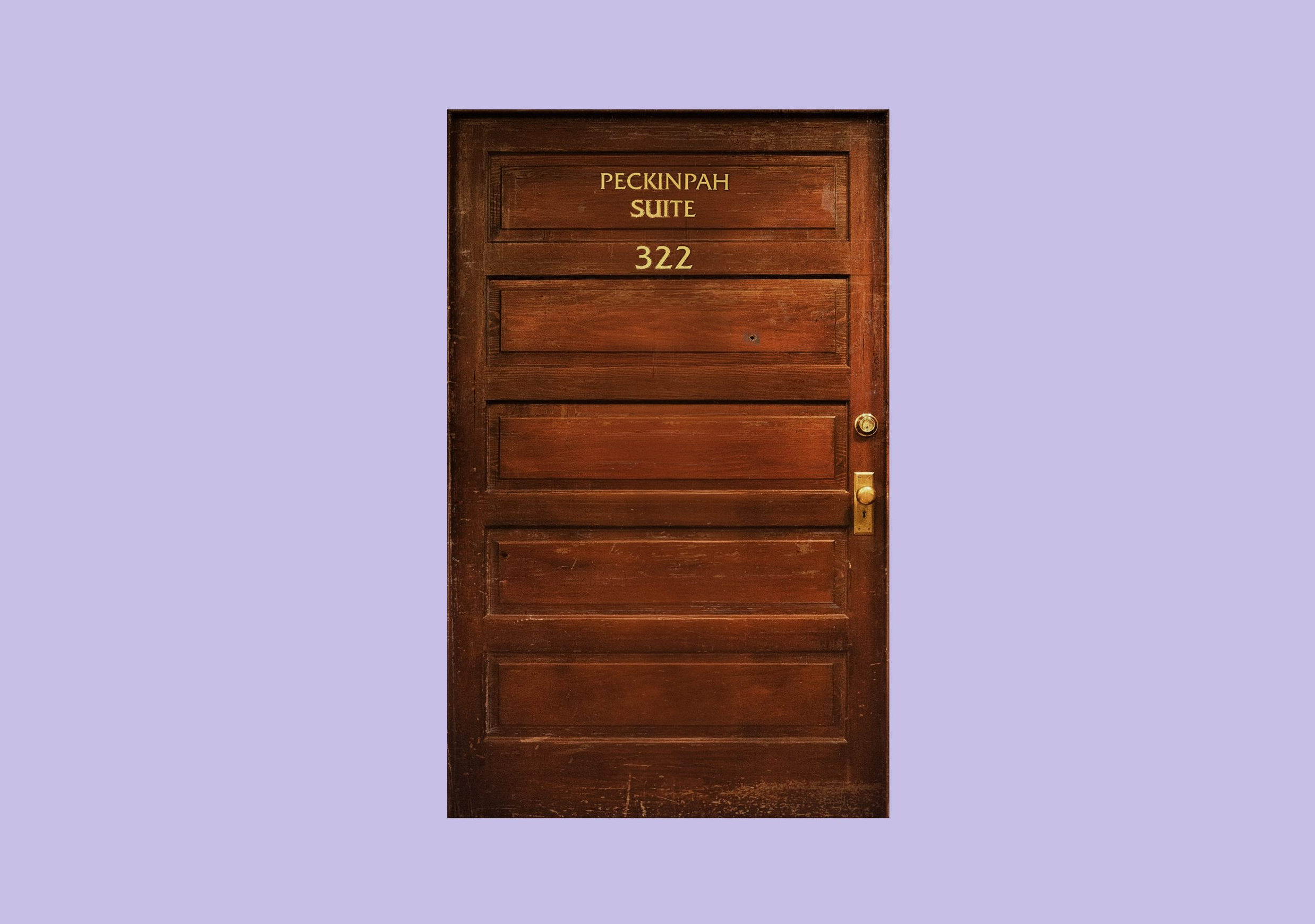
On one level, Munden’s seventh collection, Peckinpah Suite (Recent Work Press, 2025), is a poetic biography of Sam Peckinpah’s journey from growing up in 1930s Fresno to his final years in Montana, mostly spent living in suite 322 at the Murray Hotel in Livingston. Peckinpah Suite’s front cover is an edge-to-edge image of a door unsullied by any text other than the suite name and room number.* On another level, the book is an exploration of maverick genius** struggling to fulfil an artistic vision in the face of other narratives.
Sam Peckinpah first checked in at the Murray Hotel in the 1970s. He was preparing to build a log cabin on land purchased from Warren Oates, a star in two of his most celebrated (or notorious) films – The Wild Bunch (1969) and Bring Me the Head of Alfredo Garcia (1974). By then, Peckinpah had hard-earned reputations as inspired film director, Hollywood renegade and hell-raiser of note.
By coincidence, Paul and his friend Nosh, on a USA summer tour, hitch-hiked through Montana at this time:
Driving there, you pass
a couple of long-haired
backpackers, thumbs
outstretched. Last timeyou hosted any students
it ended up in a fight
and a lawsuit, so fuck ’em.(‘Cabin Fever’)
Although familiar with Peckinpah’s work, Munden, as student-traveller, was only aware of the film-maker’s close presence sub-consciously. When he and Nosh left Livingston to rough camp at Yellowstone, they told each other –
[…] a few
far-fetched yarns to ward
off our growing fears
of a first, freezing night
in the company of bears.(‘Montana, 1978’)
The bears remain metaphorical, but addressing the film-maker in the second person allows Munden to frame biographical aspects of the collection with intimacy and to vivify accounts of some films through the relationship between watching them and significant moments in his own life.
Peckinpah grew up in California’s Central Valley as a third-generation settler – his family having migrated across America within living memory. A familial sense of wild west reality informed his early film-making, prompting new approaches to Westerns in general:
Until now, a TV western
had been prime time fare
for kids. No pain.(‘The Westerner’)
However, producers struggled to accept the more complex insights into violence Peckinpah wanted to include in his films. Early in Major Dundee (1965), an Apache raid –
was torn apart
as the studio cut what
the story was all about.
We’ll never see the almost
subliminal images you shot
of the children dressed
up as those Indiansspliced into the raid.
(‘Major Dundee’)
Studios also struggled to understand (sell) Peckinpah’s softer side. The Ballad of Cable Hogue (1970) is a sweet depiction of love in a chaotic, end-of-an-era wild west that concludes with the arrival of a motor car as deus ex machina – presaging the demise of the old west and of Hogue’s enterprise, so a ‘faux tribute’ for the injured hero is –
suddenly a real funeral,
night now closing in
on his dust-blown cathedral.(‘The Ballad of Cable Hogue’)
All the extracts quoted demonstrate the easy flow of Munden’s short lines – layering image, action and meaning down the page with subtle half-rhymes. Wild Court readers met Paul’s poem about Pat Garrett & Billy the Kid (1973) in June 2025, where rhyme flows through the final verse of the poem giving refined emphasis to the ending image:
When the studio
takes all this footage
away from you
it’s both a sad crime
and fractured dream.
We do our best to piece
together every last
sliver of silvered glass.
Munden’s explorations of sonnet form during and after an International Poetry Studies Institute fellowship in Canberra are an object lesson in poetic persistence and craftsmanship. A bravura range can be found in The Bulmer Murder (RWP, 2017), while Chromatic (UWAP, 2017) and Amplitude (RWP, 2022) include fine examples of the triple sonnet’s capacity to handle raw and complex subjects with clarity, lyricism and, when needed, humour.***
Forty-two of the poems in Peckinpah Suite are triple sonnets. ‘Castaway’, the exception, forms the whole of Part II. Early on, Sam Peckinpah bought film-rights to James Gould Cozzens’ 1934 novel Castaway – about a man trapped in an abandoned department store. Munden owns an original copy of a script written for Castaway. Despite being a project Peckinpah returned to on several occasions, the film was never made.
‘Castaway’ is a poetic imagining of the film, with forty-two 7-line verses spread diagonally across 12 pages. That the poem moves with speed and clarity through one challenging scene after another is partly due to the familiar and welcome run of half rhymes. The final poem in Part I left Sam in his cabin, with Castaway fuelling his ‘darkest dreams’:
You raise a glass right here
where a friend has installed
a beautifully crafted bar,
and thrust the blade
of your hunting knife deep
into its timber,
as if it’s some desperate
argument that you’ve nailed.(‘Cabin Fever’)
Turning the page, a reader might wonder if ‘Castaway’ is in the same place. The conceit of a suite/cabin/hideaway as the location for creativity is well-established by now, while the opening lines draw on an unusual action-note relating to smell in Peckinpah’s film-script:
Dawn, and from the moment
           you open your eyes, you know
                        something's wrong with the light,
                                     like the smell of bad meat.
                                                  A sickly orange glow leaks
from the outside world
            as if from an apocalypse.
The narrative of this long piece may be unsullied by studio or producer interference, but the roles of castaway and director are difficult to distinguish, and neither is in control. When the castaway encounters a ‘disappearing shadow’, this could be evidence of a threat of some kind. Or it may be the castaway seeing themselves reflected in their surroundings. Or perhaps the poet/auteur is present in some manner? Read on…
Part III of Peckinpah Suite is valedictory. Munden returns to the triple sonnet to catch a last hurrah from Sam – consuming a flamboyant ‘Ramos Fizz’ among friends after his discharge from hospital. Later, the poet steps back from his subject, stating respectfully he is one of –
[…] those
who knew the brilliance
of your work on film
without the body blowsof first-hand experience
in its making.(‘Paradise Cove’)
In the collection’s Coda, Munden turns to social media to find another connection with and separation from the film-maker:
I scroll through notifications:
Sam Peckinpah responded
to one of your comments.
You, but not you; an avatarcurating our ongoing need
to discuss and pay tribute
to your genius.(‘The Racquet Club’)
Peckinpah Suite is an accomplished and mature piece of work by a poet working with skill and verve.**** There is ample evidence of Munden’s immersion in Sam Peckinpah’s career. However, by implication and example, this not just a sustained act of retrieval from the film-maker’s life, but also of key moments in the poet’s own life:
I didn’t expect it
to be so sad,
my daughter had said
as we came to the end.
I throw more logs
into the inglenooked stove;
feel savaged by love.(‘Solomon’s Island’)
*The original photograph of the door was supplied by the Murray Hotel in Livingston, with some digital adjustment needed, among other things, to place the handle on the right-hand side.
**In 2024, RWP published Paul Munden’s study of another maverick genius – Unclassified: Nigel Kennedy in Chapters & Verse.
***Introducing Chromatic (UAWP, 2017) at a launch event Down Under, the Australian poet Melinda Smith coined the label ‘Munden’ for the triple sonnet. With 42 Mundens in total, Peckinpah Suite represents the (current) apogee of the form.
****For clarity – I am proud to claim Paul Munden as a close and long-standing friend. We first met as undergraduates at the University of York and members of the university Poetry Society. We are friends in life and friends in poetry. I have written this review to draw the attention of UK-based readers to the remarkable body of poetry Paul has published over the last 10 years, mostly with Australian publishers. Paul spent 25 years as Director of NAWE (National Association of Writers in Education) encouraging and nurturing writers and writing in the UK. He continues to be involved, in a supportive way, with organisations like Poetry by Heart. He is a poetry activist whose own work is stimulating, relevant and rewarding.