Nicola Healey
Stephen Romer’s Night Contradicts the Day (Dare-Gale Press, 2026) comprises just five poems yet has more power than many full collections. In this very moving, personal sequence of poems, the narrator holds careful vigil over an isolated loved one’s protracted mental suffering, whose fragile, volatile hold on life and equilibrium destabilises both their lives. Romer (currently a lecturer at Brasenose College, Oxford) has previously published four full collections, three with Oxford University Press and one with Carcanet; his selected poems, Set Thy Love in Order, was published by Carcanet in 2017. The intensity of vision, focus and personal subject matter in this new pamphlet signals a marked and compelling departure from Romer’s previous work.
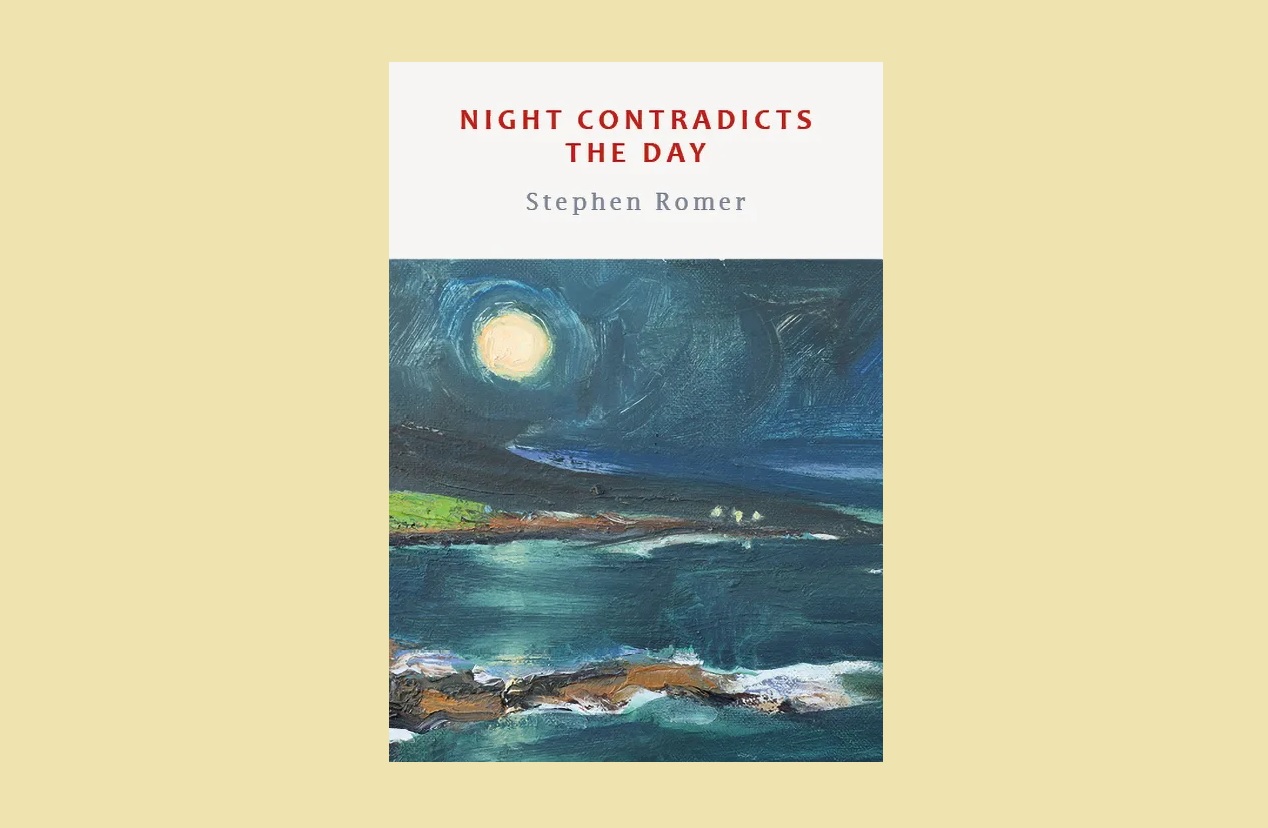
The collection’s title is immediately intriguing (as is the front cover image, a striking midnight-blue detail from Moon over Plymouth Sound, by C. E. Romer): throughout the pamphlet, a dialectic is probed between the metaphorical ‘sun’ and ‘the dark’, symbolising refuge and its opposite – a floundering, yet honest to a fault, despair. This simple metaphor is complicated by the fact that, for the addressee of these poems, the ‘sun’ and the symbolic ‘dark’ often become merged (bringing to mind the ‘Noonday Demon’). In Romer’s opening poem, ‘Sunday Afternoon’, ‘the sun merely masks the dark’; while in ‘No Refuge’, for the poem’s suffering subject, ‘the sun itself // is merely a cover / for the dark, a part // of the Cruelty Spectrum’. That word ‘cover’ suggests deceit, as though those who suffer see the world as it truly is (at least for them) – they have the wool taken from their eyes, so to speak. The poem even posits that, for the addressee, ‘poetry or art or even the breath’ (which is to say, life) is a part of this ‘Cruelty Spectrum’. The sun ‘wants to shift / power in its favour’ – wants to win us over to life, a power the addressee, in his austere logic, perceives as a threat and thus ‘dark’.
Romer’s pamphlet delicately, cleverly explores how both personal peace and suffering exist, often co-exist, and contradict, or cancel out, each other. Both contradictory states hold truth – in different ways for both the speaker and the addressee; and when these opposing states have to be held in the mind at the same time (such as when a loved one is seriously afflicted, ill or antagonistic), it brings a flummoxing cognitive dissonance, mortally compromising one’s happiness, or sense of inner harmony.
Though it is never made explicit, these poems appear to trace the troubled bond of care between a father and son. The tormented subject of the poems – who at times finds himself in ‘semi-hell’, or ‘patrol[ling]’ ‘hell’ – is a person who gets caught in distressing black-and-white, all-or-nothing, erroneous thought patterns. (In a podcast with Sally Bayley, Romer explains that these poems confront the challenges of conversing with a neurodivergent, specifically an autistic, mind. This podcast is worth seeking out, not least as Romer movingly reads several extracts from the pamphlet.) The loved one struggles to be pulled out of these bullying doom spirals, despite the speaker’s best efforts. His rigid, ‘dry’ ‘maze of […] evolving thought’ is described very effectively in ‘From the Safe Room’, a masterly 11-page poem which forms this pamphlet’s centrepiece. The speaker finds his loved one’s ‘metaphysical inquiry’ to be
excruciatingly drawn out
where the stakes are always
all or nothing, heaven or hell
or purgatory: the co-ordinates
are set by you but they shift or
gang up […]
Ultimately, it’s a severe cerebral ‘game’ (the speaker calls it ‘Russian chess’) in which the sufferer is ‘forever / cornering [him]self’; ‘an equation / that never quite comes out / or does but the result is wrong’. This agonising predicament – where uncertainty and grey areas cannot be tolerated – speaks of someone perpetually, self-defeatingly, looking for some deeper unifying ‘pure’ truth – about themselves, or the world – that will either corroborate or vanquish their despair. In this hyper-rational, almost mathematical state, worryingly, the sufferer can be more interested in being ‘right’ than ‘saved’. It made me recall a line from Virginia Woolf’s The Waves: ‘I, who am perpetually making notes in the margin of my mind for some final statement’. (Romer writes in ‘Sunday Afternoon’: ‘notebook and pencil and thought / are all he says he needs’.) Throughout Night Contradicts the Day, the speaker bears witness to an anguished, fragmentary statement-in-progress.
‘From the Safe Room’ recounts a brief truce between these two ‘warring parties’, allowing the speaker just to ‘be’ – to freshly enjoy the world again:
a moment you suspend
your patrols of hell
and my relentless purgatory
is still;and the world as she is
this deep morning
emerges fresh made
from a fortress of mist.
That arresting paradox ‘fortress of mist’ encapsulates how a seemingly intractable situation can, suddenly, emerge into a breakthrough, into joy and clarity. It is discussion of music – Bach, Gould and Gulda – that brings about this truce, allowing ‘glimpses of the old / shared mischief’. Any tentative progress they make, however, always threatens to become unstitched. The poem goes on to show how unstable such truces can be, or feel, for even music can fail some people in the very depths of suffering:
But what if Bach fails,
even, what then saves us,
what net from falling
into the metaphorless […]
This put me in mind of Emily MacGregor’s While the Music Lasts: A Memoir of Music, Grief and Joy (2025) – the best book on grief I’ve read – where MacGregor, a music historian and trombonist, with a passion for music, finds that music becomes inaccessible to her in the early stages of her grief. Romer’s feared ‘fall’ into ‘the metaphorless’ – presented here as a personal abyss – also points to how, as poets as varied as Anthony Hecht, Czesław Miłosz and Michael Symmons Roberts have described, metaphor cannot contain all extreme experiences. In Quartet for the End of Time: On Music, Grief and Birdsong (2025), Symmons Roberts writes (with regard to the impossibility of figuring ‘the end of time’ in poetry): ‘The metaphors come crashing down like stage flats as soon as you set them up. None of them will do’. I think if one accepts that, at times, the limitations of art can become exposed – whether in one’s own life or in the lives of others – this natural lacuna can eventually be incorporated into one’s personal aesthetic philosophy without it posing an existential threat.
In ‘From the Safe Room’, Romer probes that most difficult of questions: ‘when our best days / seem behind, and when we / see through everything, / even this music’, what then? T. S. Eliot’s words sprang to mind: wait. Eliot distils, in ‘East Coker’, how to live alongside helplessness:
[…] wait without hope
For hope would be hope for the wrong thing […]
But the faith and the love and the hope are all in the waiting.
Wait without thought, for you are not ready for thought:
So the darkness shall be the light.
This kind of committed patience – requiring that one dwells with unknowing and the unknowable, a profound negative capability, without words, or even thought, requiring too that one accepts this is ‘right’ rather than ‘wrong’, even though it suggests nothingness and a frustrating passivity (especially if one lives the life of the mind) – is one that Romer’s speaker has evidently called upon throughout his long trial. He talks, in ‘From the Safe Room’, of ‘the weariness of waiting’, but how ‘this too’ ‘is not the world against us’, but a necessary part of the (life-long) process of learning to live with, and alongside, suffering: ‘these walls, this block, / is a work of compassion’.
The controlled, poised tenor of ‘From the Safe Room’ – its tone, at times steely, at times tender – its emotional and intellectual rigour and artful restraint, the way it accumulates the insight and wisdom hard-won through suffering, all evoke Eliot’s Four Quartets (though Romer’s long poem is rewardingly more intimate and specific, whilst still keeping an Eliotic kind of distance). The via negativa promoted in Eliot’s masterpiece was in turn influenced by St John of the Cross’s Dark Night of the Soul – a text which feels pertinent to Romer’s own. Though this is heavy poetic material, at times heart-rending in its faithfulness to true feeling, Night Contradicts the Day is always eminently readable and gently rendered – for me, it’s Romer’s finest, most engaging work yet – and so represents a transfigurative victory of art over suffering, if only on the page, if only for the reader.
The poems are lifted, too, by lighter moments that capture the persistent beauty in life – its capacity to surprise us: one morning, the speaker is suddenly ‘blind-sided’ by Bach’s Sheep May Safely Graze: ‘out of nowhere / a capsule of purity’ (‘From the Safe Room’). Romer’s poems are determined to remain awake to, and to preserve, such inviolate spaces of purity – the balm, hope and future they represent; their sacred refuge.
It is always difficult to write about mental illness and distress from the perspective of an observer, however close that observer or ‘carer’ may be, as the person undergoing the distress is the one who is at the white-hot core of what can be unspeakable suffering, and often without agency (albeit, the carer can, in the end, become consumed by their own reactive depression or despair); Romer accomplishes this sensitive, demanding feat brilliantly. This eloquent pamphlet probes the human condition at its deepest reaches, so is of universal interest, but it will particularly resonate with anyone who has been through, or is enduring, serious mental distress; or who has lived, or lives, closely alongside it. I can’t recall reading a more touching, subtly learned, reflective and tactful sequence on this difficult territory, one which causes the reader to feel equal sympathy for both the speaker and the poems’ subject, in what is presented, at times, as a shared ‘relentless purgatory’ – and a war within that, where the speaker is forced to accept that there will be no full rapprochement. This is a dual ‘metaphysical inquiry’, looking beyond binaries, refusing ‘comforting narrative[s]’ and absolutes, dealing instead with the harder ambiguities of multifarious (dis)continuous life – the everyday frontier of one’s existing, shifting knowledge (‘From the Safe Room’). Importantly, in this ‘narrative’, Romer’s speaker remains open to, and allows space for, a way of being that is not his own, understanding that what is part of full humanity is part of a larger reality.
Many fall at the intense, unrelenting challenge of supporting someone whose distress spans years – Romer’s sequence of poems is ultimately a testament both to the unconditional love made manifest in order to care for a chronically suffering loved one, and to the endurance of the human spirit – even when that human has no conventional purpose: is ‘without an in-tray / without an out-tray’, yet is still determined to freshly face, ‘in this mottled English light, this listless day’ (‘Entropy’). ‘They also serve who only stand and wait’, Milton wrote.
The final poem in Romer’s pamphlet, the moving ‘Entropy’, features an epigraph from the psychologist Steven Pinker: ‘the ultimate purpose of life, mind, and human striving: to deploy energy and information to fight back the tide of entropy and carve out refuges of beneficial order’. Though, in ‘Entropy’, Romer wisely notes ‘how hard it is to keep on carving out // refuges in ‘inauspicious times’, or in any time / truth be told’, Pinker’s words couldn’t be a better summary for what Romer has honoured in Night Contradicts the Day – whether that ‘refuge’ be carving out a poem to battle against that ‘tide of entropy’, or simply, indefatigably, and with courage, showing up in the ‘mottled’ light of another day.