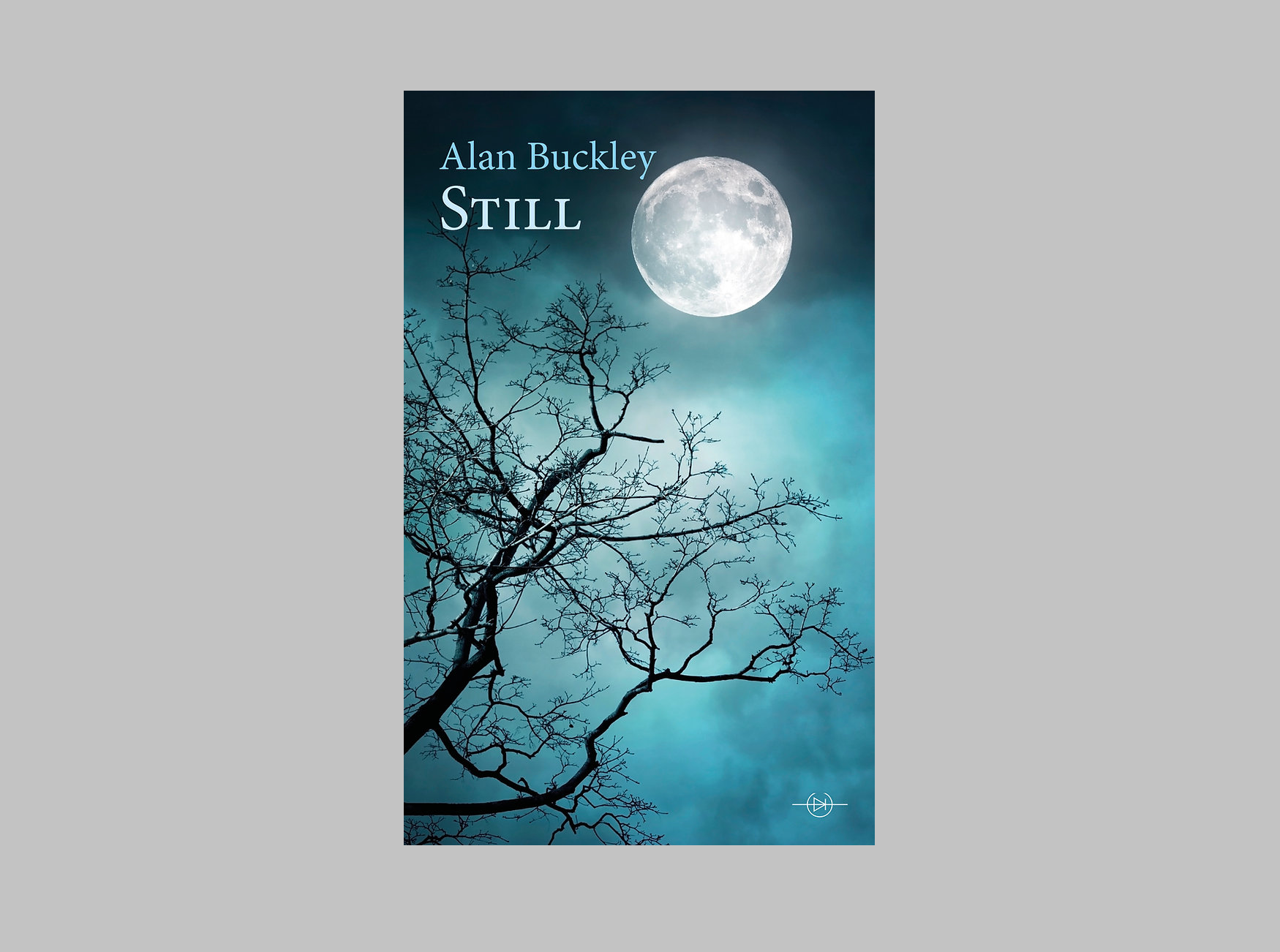
Below are two poems from Alan Buckley’s collection Still, published by Blue Diode Press in 2025. The collection consists solely of ‘douzaines’, a form invented by the author. Under the two examples included here, Alan writes about the genesis and structure of the form.
Stream
And in the year my skin was
abandoned, I walked each day
to the valley full of reeds
and rare wildflowers. Months passed.
Then something changed. The valley
began to evolve, startling
me with a daily freshness.
But in truth, I was the one
being renewed. It cradled
me, and quietly gathered
the rain of my grief, feeding
the stream that never runs dry.
Grass
Not my thing, but when my nose
catches a drift of its smoke
down by the brook in the woods
I smile, picture them huddled
in a thicket, scrimping it
into a Rizla’s vee, then
lick, a Zippo’s clank and scratch,
heads lolled back. They’re illegal
and furtive, as teenagers
should be. I bless the sweet herb
that brings them – when nothing else
will – into this perfect green.
Alan writes: In January 2021, just before the third lockdown began, I wrote a poem that fell naturally into short-lined couplets. A fortnight later I was on my regular walk from my home in East Oxford when I came across an animal’s remains in the middle of the footpath. Writing into the experience, I used the same shape to help the poem emerge. Before long I’d established a new form for myself, which I christened a douzaine: six couplets, seven syllables per line, and a single-word title. Although their scope broadened out over time, initially they were all written in response to things I experienced on that daily walk, which took me from my flat, across playing fields and a golf course, to the Lye Valley nature reserve. This is a rare piece of urban fenland that contains two SSSIs, and is home to an incredibly wide range of flora and fauna, including many plants on the England Red List of endangered species.
The seven-syllable line usefully disrupted my tendency to write in a loose version of iambic pentameter, and created an intense focus on line breaks and word choice. But also, though I didn’t see it at the time, the overall form was a visual representation of my lockdown experience – the huge amount of white space on the page and around the couplets standing in for all I’d lost from my life, with only a brief movement through green space left as something to hold onto. I shared the initial batch of thirteen douzaines with John Glenday, who encouraged me to keep writing them. He went on to offer a keen editorial eye on not just the poems in Still, but also the book’s structure. I’ve no hesitation in saying that without his steady encouragement and perceptive critiques this book simply wouldn’t exist.